
Before Middle School Breaks Your Child’s Mind:
What We’re Seeing Again This Summer.
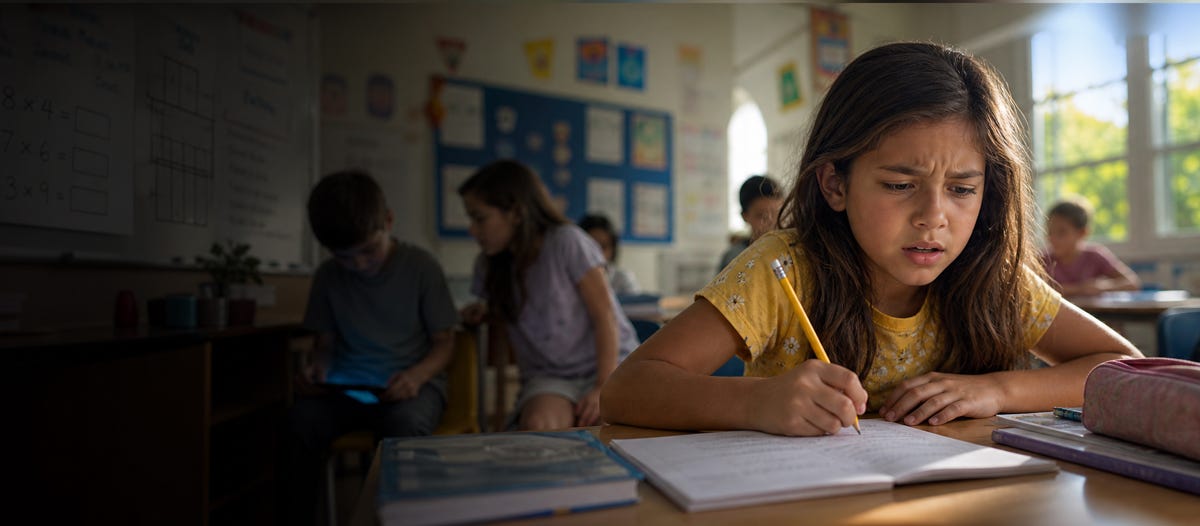
If your child is about to enter sixth or seventh grade, you are standing at one of the most decisive points in their intellectual life—and what we see every summer at Cambrian Academy should alarm you. We are not guessing about what’s happening in local schools; our summer students are living evidence that math—and organized, conceptual thinking across subjects—has gotten much worse.
Each summer, we work with students from surrounding schools who come to us for for‑credit math or to “catch up.” On paper, many of them look fine: they’ve passed, they have solid grades, and they can execute the exact kinds of problems their schools have rehearsed. But when we ask even basic questions—“Why does this work?” “What would happen if we changed this number?”—the room goes quiet.
In the 1950s, Richard Feynman described walking into a physics classroom in Rio de Janeiro and discovering that university students could perfectly recite definitions of polarized light, but could not answer a simple question about what light would actually do when it reflects off water. We see that same disturbing silence today in local middle school math students with even simpler application questions: “If this rule always works, can you show me why on a number line?” “How do you know this fraction is bigger, without a calculator?”
This is not about intelligence or effort; it is about how they’ve been taught. They have been trained in an anti‑conceptual way of doing school that rewards tricks, templates, and test‑taking over understanding. In math, that looks like:
Memorizing procedures with no grasp of the underlying ideas.
Taking beautiful, color‑coded notes that never get turned into real understanding.
Surviving so long as the worksheet looks like the example—but freezing the moment anything changes.
Middle school is where this starts to break. Arithmetic tricks that kind of worked in fourth grade cannot carry a student through using fractions, ratios, negative numbers, and algebraic thinking at the next level. The furrowed brow you see in our banner image is not laziness; it is a mind that has reached the limit of what rote and guess‑and‑check can do.
Our concern is heightened by a new trend: highly marketed “AI schools” promising to “crush academics” in just a couple of hours a day, with the rest of the day freed up for projects and fun. The branding is shiny; the claim is that AI adapts to your child so efficiently that traditional academics can be shrunk to a tiny slice of the day. But under the surface, most of these models sit on the same old Prussian factory assumptions—age‑based cohorts, fragmented content, and a focus on producing correct‑looking outputs. (and they cost a lot!)
In that context, AI is not a rescue; it is an accelerant. When the system already confuses performance with learning, generative AI makes it trivial for a student to produce polished answers and even “explanations” they do not actually understand. Recent research is already warning that students who lean heavily on AI tools can appear to improve in the short term while their independent problem‑solving and basic skills actually decline. It becomes easier than ever for a young mind to atrophy quietly while adults are reassured by the metrics.
We feel deep compassion for these students. When a rising sixth grader sits across from us in June and says “I used to be good at math,” what she usually means is: the tricks used to work, and now they don’t. She has done what the adults around her told her to do, and she is now paying the price for a system that never taught her conceptually.
Compassion, however, cannot mean leaving her there—dependent on more tricks or on AI systems to cover for a growing internal weakness. This is the moment to rebuild strength and independence, not to outsource more of the thinking.
Waiting until high school to seek a genuinely conceptual model is, in most cases, waiting too long. A sixth‑grader, by contrast, still has enough plasticity and enough school time left to rebuild reading, writing, and reasoning on honest foundations—provided the adults are willing to realign placement with reality and to insist that understanding, not appearance, is the standard, regardless of whether the building is labeled public or private.
We know there is another concern in your mind: friends. Your child wants to stay in school with the people they know. You may also worry that moving to a different environment will put them “out of sync” academically with their current cohort. That is understandable. But in education, staying exactly where the crowd is can quietly mean drifting further and further behind in real intellectual power.
A small school explicitly designed around conceptual development changes that trajectory. At Cambrian Academy, math is built as a hierarchy of ideas that must make sense to the student, not as a sequence of worksheets to complete. We demand that students show, in their own words and on fresh problems, that they actually understand; we also teach them how to defend their values and their standards of work rather than simply mirror the average around them.
Choosing a place like Cambrian Academy now is not about prestige; it is about protecting and strengthening the one thing your child will carry into every future environment: a mind capable of understanding reality and refusing to be fooled by appearances. For a rising middle schooler, that choice—made this year, not “someday”—can be the difference between years of quiet frustration and a future in which they walk into any large school, university, or workplace able to think clearly, stand their ground, and genuinely lead.
We understand that not everyone can afford private school, even when it is priced $10,000 less than all the schools that rank below it. That is why we are putting out articles that say how we do what we do. You can have a free audiobook version of our Founder’s 2026 book: Mr. Feynman Wasn’t Joking: Why the Education System Doesn’t Work, Why It Can’t Be Reformed, and What Must Replace it. The audiobook will help you recognize the three ways most teaching accidentally trains students to memorize instead of understand—so you can identify these patterns in any school environment, ask better questions of teachers, and know when and how to supplement your child’s learning to build genuine comprehension.
(If you are in the San Jose, CA area, even just one year of Grade 6 or 7 at Cambrian Academy can make a major difference in the direction a child is headed.)
The paperback version of Mr. Feynman Wasn’t Joking is now available to purchase.